Shrimp expo in Vietnam postponed due to coronavirus - SeafoodSource
A government-sponsored exhibition that was previously planned to take place in Vietnam’s Mekong Delta in March has been rescheduled to June in response to the coronavirus outbreak.
The Vietshrimp Aquaculture International Fair 2020, sponsored by Vietnam’s General Department of Fisheries and the Can Tho City government, will now take place 3 to 5 June in Can Tho. It had been set to take place 25 to 27 March.
The shrimp show is one of several activities postponed in Vietnam since the outbreak of the virus, which has forced the Southeast Asia nation to act quickly to prevent the virus from spreading further.
The show, which typically features around 200 booths, is focused on shrimp, and both domestic and foreign companies in shrimp and other seafood sectors were expected to be present at the show in March, which was set to include seminars on shrimp seed production, feed management in shrimp farming, disease management, and equipment.
The Vietnam Fisheries Association, the Can Tho Department of Agriculture and Rural Development, and Vietnam Fisheries Magazine are the joint organizers of the event. The decision to postpone was made by the local government and relevant agencies in Vietnam, the organizing committee said in a statement 12 February, adding that the postponement is aimed at ensuring public health safety and the smooth execution of the event.
The organizers said last year’s show – the second annual edition – hosted more than 10,000 visitors, including companies and individuals from the U.S, China, Europe, and India.
The rapid outbreak of the coronavirus, with an origin reportedly tracked to a seafood market in Wuhan, China, has killed more than 1,000 people in mainland China, with dozens more cases confirmed in other countries, including in the U.S, Japan, Thailand, and Germany, South China Morning Post reported 12 February.
The city of Wuhan is a major logistics hub for China’s seafood trade in central China, and the virus hit the market at its busiest time of the year. The city is also central to the trade in freshwater species like crabs given its location in Hubei Province, at the heart of China’s freshwater crustacean industry.
Shrimp eyes may hold key to developing nontoxic, non-fading paints and pigments - The Times of Israel
If you’re Jewish and observe kosher dietary restrictions, you likely have never looked into a shrimp’s eye.
However, if you have, you might have noticed that it gleams in low light. That is because the shrimp has a reflector underlying its retina (a “tapetum”) made up of tightly packed nanoparticles that allow the eye to collect more light underwater.
This was discovered by scientists from Ben-Gurion University of the Negev and the Weizmann Institute of Science in Rehovot, central Israel.
And in an example of biomimicry — developing solutions inspired by nature — the secrets of the shrimp’s eye could one day be used to develop nontoxic, reflective and nonfading paints and pigments.
The leaves of trees and other plants are green because of the pigment chlorophyll. (Shmuel Bar-Am)
Color in nature comes from three sources: pigments, such as chlorophyll which makes leaves green; bioluminescence, a chemical reaction that produces light as seen in a firefly; and structural colors.
Structural colors result from the interaction between waves of light and tiny structures. In the case of the shrimp’s eye, the color arises from the way minuscule crystal plates are arranged.
“It’s not often that new principles in optics are revealed by biological systems,” said Dr. Benjamin Palmer, a member of BGU’s Chemistry Department, lead author of a paper on the subject published in Nature Nanotechnology, and the recent recipient of a prestigious starting grant from the European Research Council, which seeks studies with the potential to break boundaries of scientific knowledge.
Close-up of a tapetum in a shrimp’s eye. (Dr. Ben Palmer and Dr. Venkata Jayasurya Yallapragada)
Fascinated by optical crystals in biology, Palmer, from Wales in the UK, began his postdoctoral research at the Weizmann Institute and teamed up with institute postdoctoral fellow Dr. Venkata Jayasurya Yallapragada to map the crystals and determine their properties.
The shrimp’s reflector is composed of a close-packed assembly of spherical nanoparticles. Each nanoparticle is constructed from hundreds of crystal plates arranged in concentric layers around a hollow core, closely resembling an onion.
The Palmer group is now trying to understand how shrimps produce such complex particles in the hope that they can be recreated in the lab.
Union criticizes Black Cove shrimp plant closure in Canada - Undercurrent News
The permanent closure of a processing plant in Newfoundland and Labrador, Canada, after it was completely destroyed in a fire last year is devastating for the community, according to a union leader representing some 75 fish plant workers in Black Duck Cove, CBC reported.
The Black Duck Cove plant was owned by Gulf Shrimp, a joint venture between Royal Greenland's QuinSea Fisheries, and Quinlan Brothers.
Eva Applin, a representative with the local United Food and Commercial Workers chapter, said Gulf Shrimp has the resources to reopen the plant but is refusing to do so, despite promising to keep the entire workforce employed after a fire at a shrimp plant last spring.
The company made its closure official in a media release last week, saying poor shrimp quotas that the company won't sustain reinvestment in the facility.
Although shrimp stocks are falling, the lobster fishery is thriving, Applin noted, suggesting the plant is being used to process lobster instead.
Best Shrimp & Grits Recipe From Husk Charleston - How to Make & Cook Shrimp & Grits - Parade
With Mardi Gras underway and Fat Tuesday coming up on February 25th, all we can think about is good ol’ Southern classics like Gumbo, Dirty Rice, Po’boys—and Shrimp & Grits. If you’ve ever been to Southern cities like New Orleans, Charleston and Atlanta, chances are you’ve probably tried the traditional Lowcountry delicacy first hand and if you haven’t, we’re sorry for your loss. To ease the pain, we scored a few tips (and a recipe) for how to make Shrimp & Grits at home, courtesy of our favorite Southern chefs.
What is Shrimp & Grits?
“Shrimp & Grits is a classic South Carolina dish,” explains executive chef Travis Grimes of Husk Charleston. “The dish was born out of availability, since Charleston and the Lowcountry are surrounded by water, making shrimp readily available. Grits were historically grown in the Charleston area, and therefore used in local cuisine. Today the cultivation of grits has decreased, but Greg Johnsman from Geechie Boy Grits is keeping the history alive, reviving heirloom varieties for us to use.”
The short answer is no. According to chef Isaac Toups of Toups Meatery in New Orleans, good shrimp is crucial. “It sounds obvious, but I can’t harp on this enough: use quality unfrozen shrimp with the heads on,” he says. Also seasoning (specifically pepper) is key. Toups uses a a combo of Aleppo/cayenne and black pepper on his shrimp.
“Since this dish is all about the sauce, I like to take shrimp stock, Worcestershire and lemon juice and reduce it by half. After you sear the shrimp, deglaze with this liquid and make sure to crush the shrimp head with the back of the spoon—this will release all the juices.”
Be careful not to overcook the shrimp though. “It’s very easy to do this, but you have to keep an eye on them since they cook very fast, says Nina Compton, chef/owner of Compère Lapin and Bywater American Bistro in New Orleans. “You know they are done when the exterior turns pink and the flesh is slightly opaque and a little white in color.”
What kind of grits should you use in Shrimp & Grits?
“Always use stone ground grits,” says Toups. “Cool them in chicken stock and milk, then finish them with a large knob of butter and make sure to cook them until soft. No one likes crunchy grits.”
Compton is quick to point out the importance of stirring as well. “The secret to creamy grits is stirring! You have to stir continuously to achieve a creamy and smooth texture,” she says. “I love when grits are rich in flavor—heavy cream, cheese and butter will do the trick.”
Do I have to use sausage in Shrimp & Grits?
While most Shrimp & Grits recipes call for smoked sausage, a great substitute is either chorizo or Tasso Ham, according to chef Brian Landry of Jack Rose in New Orleans and Marsh House in Nashville. “If you prefer spice to smoke as a dominant flavor, both of these raise the heat level while reducing the smokiness of the dish.”
What do you serve with Shrimp & Grits?
As for what to serve Shrimp & Grits with, Toups says never to skip the soppin’ bread. “Yes, this is a two-starch dish—deal with it. If the grits are made properly, they will be a little loose so you WILL want the extra sauce left over on the bottom of the plate for crusty French bread.”
Compton encourages experimenting with toppings, too. “Shrimp & Grits is meant to be an easy, yet satisfying, dish so it shouldn’t feel like a chore. Just have fun with it and make it your own by adding different toppings like a fried egg.”
Get the recipe: Husk’s Shrimp & Grits
“We aren’t reinventing the wheel with our Shrimp & Grits recipe, but the flexibility of this dish allows us to make it our own,” says Grimes. “We use seasonal local ingredients to showcase the freshest produce when available and rely on the larder when it’s not.”
Add 4 tbsp. of butter to a large sauce pan over medium heat; sweat down onion and fennel until translucent.
Add salt and pepper to taste; deglaze with 1 cup of white wine and scape up brown bits.
Reduce until pan is mostly dry, then add tomatoes and shrimp stock and let simmer for ½ hour over low heat, stirring occasionally. Add ½ cup heavy cream and cooked sausage, then turn heat off and keep warm until needed—or chill and reheat when needed.
Shrimp Directions:
In a separate sauté pan, add 4 tbsp of butter and sauté shrimp until opaque.
Add hot sauce and lemon juice to taste, about 1 tsp each.
To serve, add shrimp to sauce and stir to incorporate. Serve grits in a bowl and ladle shrimp and sauce over grits, then garnish with scallions.
(WSAZ) -- Don't feel like going out for Valentine's Day? Chef Jason Smith shows us an easy recipe you can make with or for your sweetheart from the comfort of your own home!
Enjoy Valentine's Day from home with this recipe from Chef Jason Smith.
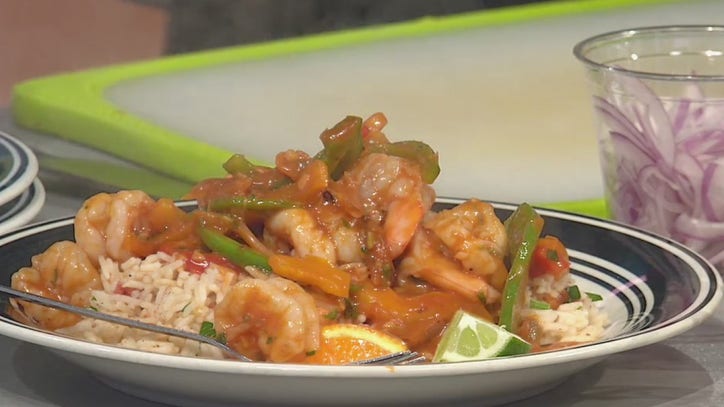
Good Day Cooks: Shrimp with sweet pepper and jasmine rice - FOX 7 Austin
Ilbersalle Fallon with Niella Catering stopped by the Good Day Austin studio to teach Leslie Rangel how to make shrimp with sweet pepper and jasmine rice. Niella Catering does traditional catering for special events such as weddings and Christmas dinners, as well as personal chef and creative catering activities.
Ford thinks people will be making out and eating shrimp in the electric Mustang Mach-E - Fox News
Ah, there’s nothing like young love … and cold shrimp.
Ford has a few ideas about the appeal of its upcoming electric Mustang Mach-E SUV that don’t involve driving range or charging times. The automaker has commissioned a survey that discovered three out of four people are more likely to date someone who drives an electric car, in part because it makes them seem “smart” and “conscientious.”
Ford thinks the findings fit with the Mustang’s history as a make-out machine, but you might want to bring some mouthwash along if you follow the company’s other social suggestion for the car.
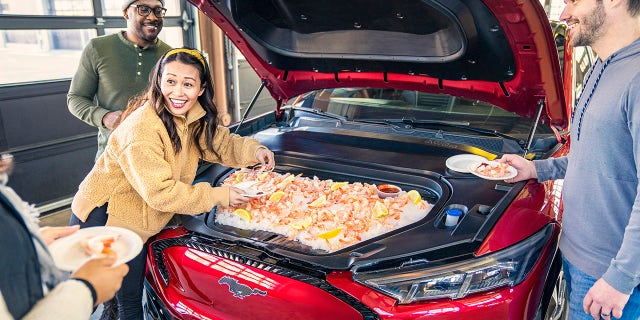
It recently demonstrated how the waterproof and washable front trunk that takes the place of an internal combustion engine can be filled with ice and shrimp, or accommodate 1,000 buffalo wings for a party.
Perhaps it’s not as “emissions-free” as advertised.
Raising the bar for shrimp breeders - The Fish Site
Called the the AQUAarray HD, it has been developed by the Center for Aquaculture Technologies (CAT), a leader in the field of genetic improvement of aquatic species.
”CAT is proud to offer practical tools that accelerate genetic improvement in aquaculture. When we combine the flexibility of this array with the analytical expertise of the CAT Genetics team, we are able to provide our partners and clients with results that they can use to increase the accuracy of selective breeding,” said VP of business development, Debbie Plouffe.
“The price point of the AQUAarray HD [vannamei] allows any sized shrimp breeding company in the world to leverage the benefits of genomic selection for genetic improvement."
Developed in collaboration with Neogen and available now from The Center for Aquaculture Technologies, it is the first product to be released in the AQUAarray line and can be used for a variety of applications including parentage assignment, assessment of genetic diversity, traceability, genomic selection and more.
Cuttlefish skimp on lunch when there’s shrimp for dinner - sciencefocus.com
When cuttlefish know that their favourite food will be on the menu at dinnertime, they’ll eat less for lunch, according to new research carried out at the University of Cambridge.
Advertisement
Cuttlefish are a type of cephalopod mollusc and they have a wide diet that includes crab, fish, squid and shrimp, but they show definite preferences for particular foods.
Read more about cephalopods:
After establishing that shrimp was the favourite food of European common cuttlefish (Sepia officinalis), the researchers found that when they reliably gave the cuttlefish a meal of shrimp in the evening, they’d eat fewer crabs when they were offered during the day.
When the shrimp dinners were only provided at random, the cuttlefish would eat more crabs in the daytime as they could not predict if their favourite food would be available later on.
“It was surprising to see how quickly the cuttlefish adapted their eating behaviour – in only a few days they learned whether there was likely to be shrimp in the evening or not. This is a very complex behaviour and is only possible because they have a sophisticated brain,” said Pauline Billard, who took part in the research.
When cuttlefish hatch out, they already have a large central nervous system and are able to learn from a young age. They are capable of responding to their environment in a flexible fashion, and can adapt their hunting, mating and behaviour strategies to ensure the best possible outcomes.
In this study, they proved that they could adjust their foraging behaviour on a day to day basis to guarantee that they were eating enough, but also not missing out on their favourite foods.
Advertisement
In evolutionary terms, cephalopods split from vertebrates around 550 million years ago. These findings could offer new insight into when complex cognitive ability evolved.
Reader Q&A: How do octopuses move their limbs if they have no bones?
Asked by: Toby Graham, Shrewsbury
Octopus arms work in a similar way to an elephant’s trunk, a snail’s foot and your tongue. Known as ‘muscular hydrostats’, these structures consist almost entirely of densely packed muscles.
By combining in different arrangements, the muscles can provide an impressive range of movement. When octopuses crawl along the seabed, they contract lengthwise and crosswise muscles in their arms, elongating and shortening their arms in turn. They twist their arms by contracting sets of muscle fibres that wrap diagonally around them.
Farmed shrimp prices set to drop substantially, EU importers keeping an eye on coronavirus - Undercurrent News
Credit: Phensri Ngamsommitr/Shutterstock
With the Chinese New Year holiday period over and coronavirus still spreading in the country, the global farmed shrimp industry is still uncertain of what is to come in the following months.
However, it seems shrimp prices may be about to drop substantially in the next few days, various industry sources told Undercurrent News.
“Ecuador is about to collapse and prices will substantially go down next week. Some companies are no longer exporting shrimp to China at the moment, [and are] opening new markets and exporting mainly to the EU," one EU source close to the Ecuadorian sector told Undercurrent. "Before the New Year, things were already difficult for Ecuador. The market suffered a lot, because of the Chinese shrimp bans, but now the situation is far worse."
“We expect China could close the borders completely at any time now. Ecuadorian shrimp exporters are now harvesting every day to free up space in the ponds, knowing that, if the Chinese borders finally close, the product will get stuck in the sea or in their plants," the EU importer said.
Over half of Ecuadorian shrimp (see charts below, from the recent Global Seafood Market Conference) is sent directly to China and about 80% of the Latin American shrimp plants export to the Asian country, which means the situation could end in disaster, according to the source. "If the situation continues this way, it would entail a huge downturn for the Ecuadorian shrimp industry," the source added.
As it is, it seems shrimp market prices have already started to fall in India, "very fast due to the ongoing issues with coronavirus in China", according to Sea Gem Aqua Farms' owner Durai Murugan. He advised all shrimp farmers through his LinkedIn account to delay stocking and to harvest immediately if they are planning to soon.
According to Murugan, "30 Indian rupee ($0.42) have fallen within one day", he posted on Feb. 6.
Two shrimp importers in Spain shared with Undercurrent their views on how the coronavirus alert is leading the industry to a "dangerous situation characterized by high market volatility".
“As soon as the Ecuadorian exporters see the slightest hint that everything could return to normal, prices will abruptly rise,” the first Spanish source commented.
The market has all its focus on the current development of events and “what is coming next will depend on how long the alert lasts”, the second Spanish source said. “The industry is now living a time of great uncertainty and it seems hard to bet on prices going up."
“It is a matter of demand, however. Demand in China is the big unknown challenging the industry now, regardless of what happens with the virus. There is not an actual risk of coronavirus affecting shrimp so the focus may be on the impact this situation has on the Chinese economy and the country's demand for this specific product," he said.
Sources also told Undercurrent that large companies -- declining to name which -- could be pushing Latin American shrimp exporters to close one-year contracts, when all they really want to do now is sell the same volume they were exporting to China to other markets almost instantly. "Which is impossible. It is such a large volume that all other Ecuadorian shrimp importers such as the US and the EU will never be able to assume."
"I don't think establishing long-term contracts is a good idea at the moment, however. Prices are expected to decrease significantly and will make absolutely no sense," the second Spanish source pointed out.
Body recovered of final crew member missing from capsized shrimp trawler - OBXToday.com
F/V Papa's Girl [image courtesy Facebook]
The body of the final crewman missing from an Engelhard shrimp trawler that sank one month ago has been recovered from the Pamlico Sound.
Sammy Douglas’ remains were found Tuesday by the crew of a N.C. Ferry Division watercraft, WCTI-TV reported Thursday.
The M/V Papa’s Girl capsized in a storm on January 7. Douglas, Keyron “Breezy” Davis and Capt. Floyd “F.G” Gibbs died, while Ben Poe survived.
Previous Story, Jan. 14, 2020:
The remains have been recovered of one of the crewmembers missing from a shrimp trawler that capsized in the Pamlico Sound last week.
The body of Keyron “Breezy” Davis was recovered Friday morning. The Hyde County Sheriff’s Office told WCTI-TV his body was found using sidescan sonar.
Along with the Sheriff’s Office, commercial fishing vessels and volunteer boaters have continued searching off Engelhard for Sammy Douglas as weather conditions have allowed.
Four men were onboard the F/V Papa’s Girl when it went down as a strong cold front crossed the sound the evening of January 7.
Capt. Floyd “F.G.” Gibbs died at Sentara Albemarle Medical Center after being rescued by the Coast Guard along with crewman Ben Poe. Poe was treated for hypothermia and released from the hospital the next day.
A Facebook fundraiser for the families of the men lost and Poe had raised nearly $14,000 as of Tuesday morning.
Donations of Amazon gift cards are also being requested using this link, and directing the donation to Funddonation356@gmail.com.
Previous story:
The U.S. Coast Guard on Thursday afternoon suspended the search for two crew members who remain missing after their shrimp trawler went down Tuesday night in the Pamlico Sound.
The captain of F/V Papa’s Girl died after the vessel sunk Tuesday evening as a strong cold front blew across the area.
Crews from U.S. Coast Guard stations Oregon Inlet, Hatteras Inlet and Elizabeth City called on local mariners to help the search for Keyrn Davis and Sammy Douglas, who have not been seen since the F/V Papa’s Girl capsized.
Video shows Coast Guard Chief Petty Officer David Downham, a rescue swimmer at Coast Guard Air Station Elizabeth City, pulling a survivor from a life raft and helping him into a MH-60 Jaywalk’s hoisting basket:
The Coast Guard and partner agencies searched approximately 1,170 square miles since a distress signal came in Tuesday about 7 p.m.
The Coast Guard said Tuesday night they launched an HC-130 Hercules aircrew from Air Station Elizabeth City to conduct search patterns for the two missing mariners, along with 47-foot Motor Lifeboat crew from Coast Guard Station Oregon Inlet.
A second 47-foot Motor Lifeboat crew from Station Hatteras Inlet was scheduled to conduct additional searches throughout the night.
According to a “pon-pon” broadcast from the Coast Guard on VHF channel 16, the search area was centered 5.5 miles east of Engelhard.
Pictured is a graphic depicting the approximately 1,350 square miles of combined search patterns conducted by Coast Guard assets in search of two missing mariners, Jan. 9, 2019, in Palimico Sound, North Carolina. The two mariners were reported missing after the commercial fishing vessel Papa’s Girl capsized in the vicinity of the Pamlico Sound. (U.S. Coast Guard graphic)
“The marine environment is a dangerous place to work because of the cold water, rough seas and high winds,” said Rear Adm. Keith Smith, commander of the Fifth Coast Guard District. “At this point, we’ve decided to suspend further search efforts for the two missing mariners, pending further information. Our thoughts are with the families and we are very grateful to the master of the vessel, whose EPIRB saved the life of the survivor.”
Previous story: The Coast Guard’s Fifth District command center said they received a distress signal from an emergency position indicating radio beacon registered to Engelhard trawler.
The trawler went down Tuesday as a strong cold front moved across the sound around 7 p.m.
A Weatherflow sensor near the wreck site between Long Shoal and Engelhard, registered sustained west winds of around 30 mph, with wind gusts of over 50 mph around the same time when the boat went down.
One of the men rescued was able to reach a life raft, while another was found in the water, according to a relative.
A 47-foot Motor Lifeboat crew from Coast Guard Station Hatteras Inlet and an MH-60 Jayhawk helicopter aircrew from Coast Guard Air Station Elizabeth City were launched to respond.
Once on scene, the aircrew located two of the four crewmembers and transferred them to Sentara Albemarle Medical Center in Elizabeth City for treatment.
Both mariners rescued were hypothermic, according to the Coast Guard.
WCTI-TV reported crewman Ben Poe has since been released. However, family members confirmed that Capt. Floyd “F.G.” Gibbs, who was given C.P.R. after being pulled from the water, was later pronounced dead at the hospital.
A first light search was conducted Wednesday morning by Coast Guard Air Station Elizabeth City aircrew members but they were unable to find the two other missing crewmembers, Keyron Davis and Sammy Douglas.
A 47-foot Motor Lifeboat crew from Station Hatteras Inlet, along with the North Carolina Wildlife Resources Commission and a good Samaritan vessel Aubrey Niel, were still searching for the pair Wednesday afternoon.
“This is a rough case and as we continue to search, our thoughts are with the families of the mariners,” said Matthew Brooks, search and rescue coordinator for the case.
“We’re grateful for the EPIRB that was activated during the case, which enabled us to get resources on-scene as quickly as possible,” Brooks said. “A properly registered EPIRB is a vital and highly-recommended piece of equipment for mariners to have on their vessels.”
This is a developing story, stay with OBX Today for updates.
How artificial shrimps could change the world - The Economist
FOR A LONG time, beef has been a target of environmentalists because of cattle farming’s contribution to global warming. But what about humble shrimp and prawns? They may seem, well, shrimpy when compared with cows, but it turns out the tasty decapods are just as big an environmental problem. The issue is not so much their life cycle: shrimp (as UN statisticians refer to all commonly eaten species collectively) do not belch planet-cooking methane the way cows do. But shrimp farms tend to occupy coastal land that used to be covered in mangroves. Draining mangrove swamps to make way for aquaculture is even more harmful to the atmosphere than felling rainforest to provide pasture for cattle. A study conducted in 2017 by CIFOR, a research institute, found that in both these instances, by far the biggest contribution to the carbon footprint of the resulting beef or shrimp came from the clearing of the land. As a result, CIFOR concluded, a kilo of farmed shrimp was responsible for almost four times the greenhouse-gas emissions of a kilo of beef. Eating a surf-and-turf dinner of prawn cocktail and steak, the study warned, can be more polluting than driving across America in a petrol-fuelled car.
Eating wild shrimp is not much better: catches are declining around the world as a result of overfishing. Trawlers can pull as much as 20kg of by-catch from the sea for every kilo of shrimp. And reports abound of the appalling treatment of workers on shrimp-fishing vessels, including human-trafficking and child labour. When UN investigators interviewed a sample of Cambodians who had escaped virtual slavery on Thai fishing boats, 59% of them reported seeing fellow crew-members murdered by the captain.
Most of the world’s shrimp and prawns come from Asia. The continent accounts for 85% of the farmed sort and 74% of the wild catch. Global sales were around $45bn in 2018 and are thought to be growing by about 5% a year. But the industry is controversial, not just because of its part in global warming. Razing mangroves also leaves coastal regions vulnerable to flooding. Many shrimp farms are unsanitary; ponds often have to be abandoned after a few years because of problems with disease and pollution.
All this has given one Singaporean company a brain wave. “Farmed shrimps are often bred in overcrowded conditions and literally swimming in sewage water. We want to disrupt that—to empower farmers with technology that is cleaner and more efficient,” says Sandhya Sriram, one of the founders of Shiok Meats. The firm aims to grow artificial shrimp, much as some Western firms are seeking to create beef without cows. The process involves propagating shrimp cells in a nutrient-rich solution. Ms Sriram likens it to a brewery, disdaining the phrase “lab-grown”. Since prawn-meat has a simpler structure than beef, it should be easier to replicate in this way. Moreover, shrimp is eaten in lots of forms and textures: whole, minced, as a paste and so on. The firm is already making shrimp mince which it has tested in Chinese dumplings. It hopes the by-product of the meat-growing can be used as a flavouring for prawn crackers and instant noodles. Eventually it plans to grow curved “whole” shrimp—without the head and shell, that is.
The hitch is that producing shrimp in this way currently costs $5,000 a kilo. Shiok Meats thinks it can bring the price down dramatically by using less rarefied ingredients in its growing solution. People want to know more about where their food comes from and how it is harvested, argues Ms Sriram. “Cell-based technology is one of the ways to provide that accountability.” And even ordinary shrimp, whether farmed or fished, come at a heady price.
This article appeared in the Asia section of the print edition under the headline "How artificial shrimps could change the world"
Cuttlefish opt for lighter lunch when shrimp is on the dinner menu - UPI News
Feb. 5 (UPI) -- When cuttlefish know their favorite food, shrimp, is on the dinner menu, they eat fewer crabs throughout the day, according to a new study.
The findings, published Wednesday in the journal Biology Letters, offer proof that cuttlefish can learn from their experiences, recognizing feeding patterns, and adjust their eating habits accordingly.
"It was surprising to see how quickly the cuttlefish adapted their eating behavior -- in only a few days they learned whether there was likely to be shrimp in the evening or not," Pauline Billard, a doctoral student in the psychology department at the University of Cambridge, said in a news release. "This is a very complex behavior and is only possible because they have a sophisticated brain."
Cuttlefish alternate between two different feeding modes, selective or opportunistic. In lab experiments, scientists regularly provided specimens of European common cuttlefish, Sepia officinalis, with a single shrimp each evening.
The cuttlefish quickly picked up on the pattern and began eating fewer crabs during the day. When the cuttlefish knew they could count on a shrimp dinner, they were more selective.
When researchers only provided shrimp sporadically, the cuttlefish were more opportunistic, eating more crabs throughout the day.
Though cuttlefish are generalist eaters, they also show strong food preferences. Researchers were able to determine the cuttlefish's favorite food by placing crab and shrimp at equal distances from the test specimens. The cuttlefish consistently consumed the shrimp first.
Like their cephalopod relatives, cuttlefish are born with an already well-developed central nervous system, allowing them to begin learning from their experiences and recognizing patterns at a young age. Scientists suspect the cognitive abilities of the cuttlefish allow the animals to adapt to changing environmental conditions.
Though cephalopods, a group of mollusks that include octopi and squid, diverged from vertebrates some 550 million years ago, their central nervous systems are organized similarly.
"This flexible foraging strategy shows that cuttlefish can adapt quickly to changes in their environment using previous experience," said study leader Nicola Clayton, professor of psychology at Cambridge's Department of Psychology. "This discovery could provide a valuable insight into the evolutionary origins of such complex cognitive ability."






 As it is, it seems shrimp market prices have already started to fall in India, "very fast due to the ongoing issues with coronavirus in China", according to Sea Gem Aqua Farms' owner Durai Murugan. He advised all shrimp farmers through his LinkedIn account to delay stocking and to harvest immediately if they are planning to soon.


